Four Caradigm employees (Bryan Ferrel, Kathleen McGrow, Michele Kirkpatrick and Larry Nicklas) volunteered on a medical mission in Ecuador earlier this month. We asked Larry Nicklas, a Senior Product Manager for Caradigm, to share a few thoughts about his experience. It is a timely reminder that we have much for which to be thankful. Happy Thanksgiving!
What organization did you go with?
I went as part of a team organized by Microsoft that goes on an annual trip through Timmy Global Health (TGH) who works to strengthen local health systems and help end health disparities. We were based out of Tena, located in the Amazon Basin and would visit different villages each day that were 30 minutes to 3 hours away. Tena is the capital of Napo Province, about a 6 hour bus ride from Quito, the capital of Ecuador where we flew into.
What is healthcare like in Napo Province?
There’s a lot of health issues for the villagers that we visited with. Virtually everyone had a fever, cough, runny nose, and many had fleas and rotting teeth. Chronic conditions such as hypertension and diabetes were also common. In terms of healthcare resources, it’s pretty barren. A ”brigade” from TGH tries to visit 2-4 times a year. Usually, the nearest hospital is many hours away, but the locals don’t have transportation. If you can hitch a ride to the hospital, it’s like being in a facility from the 1920s.
What was the goal of the medical mission?
Each day, we set up temporary clinics in various villages to help as many people as possible get treatment, education and basic tools to improve health. It was pretty hectic as we were seeing as much as 125 people a day at a single clinic, from newborns to people in their 60s. Folks that need treatment beyond what we can provide on the ground are referred to other facilities, and TGH pays for these services.
What was the process like for patients?
The process was very similar to what patients experience here, although the setting and facilities were obviously quite different. Patients would be registered in a rudimentary EMR, then move on to different stations where they would explain why they need care, get basic vitals, can get blood and urinalysis work done, consult with a clinician, then get meds from the Pharmacy station, which was basically two dozen suitcases and plastic bins broken out by different drug categories. Most volunteers were assigned to different stations each day.
Did it change your perspectives on healthcare in the U.S.?
It made me think about how we have easy access to healthcare, but too often don’t bother to use it compared to people who desperately need it, but don’t have a means to receive it. It also made me think about how easy it should be for us to maintain a healthy lifestyle and take care of ourselves better given the environment we live in.
Did you have a favorite moment from the trip?
I’d have to say it was a tie between interacting with the children and forming relationships with the incredible volunteer team. It was really eye opening for me to see people with so many medical and socio-economic problems who could still find it so easy to smile, laugh and play. There was also a deep camaraderie that developed within the team because of the unique experience we went through together - living in shacks in the jungle; seeing heartbreaking things in the villages, rallying each other to do our best to help. It was an amazing and emotional trip. I went to learn about a different culture and wound up also learning a lot about myself. We are truly lucky and blessed to live where we do.
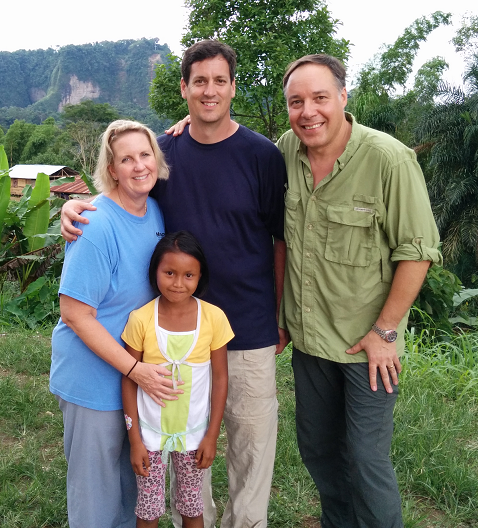
Kathleen, Bryan, and Larry with a new friend