Tag Archives: Care Management

Engaging High Risk Patients through Care Management (Part 2)


Post by Vicki Harter


Vice President, Product Management-Care Coordination

In part one of this post on engaging high-risk patients through care management, I discussed how different patient segments require different levels of care management relationships and tools. For the highest risk patients, a patient engagement strategy is centered on high intensity care management. Next, let’s look at how technology can help care management have a greater impact on outcomes for the highest risk segment.

Coordinating Care Across a Multi-Disciplinary Team

The care for a high risk patient can involve a large team including multiple specialists, pharmacists, care managers, office assistants, community health organizations and family members or friends. Coordinating activities among a diverse team requires shared access to a longitudinal patient record that gives a comprehensive “360 degree view” of the patient. The 360 degree view includes information such as:

  • Claims data (e.g. services obtained, medications, etc)
  • Dynamic care plans
  • Lab results
  • Medications
  • Patient outreach information
  • Patient supplied information (biometrics, logs/journals, preferences, etc.)
  • Predictive analytics such as a readmissions risk score, clinical risk, forecasted cost, etc.
  • Barriers to care
  • Gaps in care/quality measures that need to be closed
  • Important non-clinical information (e.g. patient motivation, family support team members, life events such as a recently deceased spouse, and other social factors)

With this enriched view of the patient, care team members across the continuum can work more efficiently together closing gaps in knowledge and communication while operating at the top of their license. This can result in reduced redundancy in assessments, surveys and tests. Today, enterprise population health technology can bring together and make available all of this information in a shared workspace even if the information is stored in disparate IT systems.

Incorporating a patient-centered approach

A deeper understanding of patients helps drive a patient-centered approach, which is critical for patient engagement. For example, if a patient is motivated to achieve a certain goal such as travel to her daughter’s wedding, then every member of the care team can reinforce her motivation and encourage the patient and engage them in the plan of care. If every care team member has access to all patient information, then patients won’t have to repeat the same information to different care team members and patients begin to sense coordination among providers. If there is a family member, friend or community organization that plays a key role in the patient receiving care, then that critical piece of info will be incorporated into the assigning of tasks. The end result is a personalized plan of care. If patients see that the entire team “knows” them, it improves the overall patient experience, builds trust and can improve engagement.

Optimizing time with patients

Care managers are often challenged by a high volume of daily manual tasks. For example, in order to assess a patient and complete a care plan, care managers must track down and synthesize information from multiple systems and offline sources. With a full case load, efficiency is a challenge that ultimately impacts the amount of time care managers can spend focused on patients. Technology can help care managers spend more time with patients by automating time-consuming tasks. For example:

  • Care plans, task lists and interventions can be automatically generated and updated from assessment responses
  • Complete medication histories can display order history and fill history to enable faster review and support compliance review
  • Patient workloads or specific tasks can be reassigned to other care managers or support staff, assuring “top of license” activity
  • High risk patients can be tracked across the continuum through event-based alerts (e.g. admissions, discharges or blue tooth device alerts).

To summarize the main takeaway from both posts, patient engagement and care management strategies are closely linked and should be tailored by segment. As part of population health initiatives where the focus is often on high-risk patients, patient engagement strategies should be on a one-to-one basis, and linked to relationship building through high-intensity care management. New population health technology has emerged to help coordinate care for the highest risk patients. As more providers make the shift to value-based care and seek efficiencies to help them scale programs, I believe that technology will play a central role in helping the highest risk patients. If you’d like to discuss your care management strategies in more detail then send us a note here.

Engaging High Risk Patients through Care Management (Part 1)


Post by Vicki Harter


Vice President, Product Management-Care Coordination

One of the most challenging issues in healthcare today involves “patient engagement”. It is defined by the Center for Advancing Health as “Actions individuals must take to obtain the greatest benefit from the health care services available to them”. The importance of patient engagement is undeniable. Patients active in the participation of their own care have a greater likelihood of achieving successful outcomes. How providers should approach patient engagement for different patient segments is still an evolving science. Patient engagement requires different levels of care management relationships and tools for different segments. In this two-part blog post, I am going to focus on the highest risk segment, and will address lower risk segments at another time.

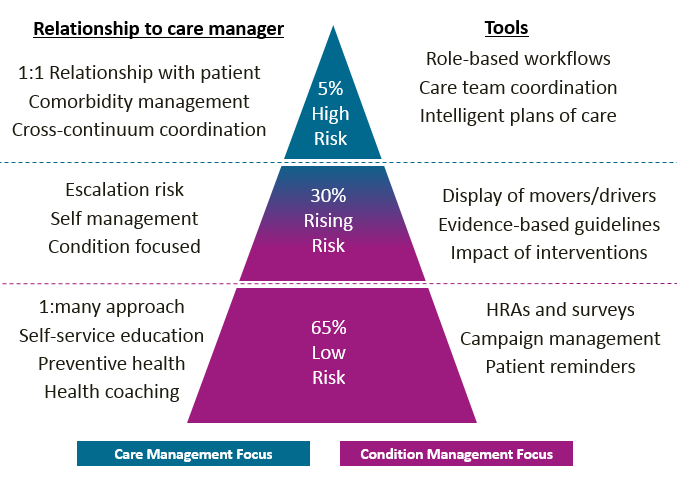
Population health management is a large undertaking, requiring a variety of approaches to assure broad impact. The figure below shows an example of patient segmentation along with the types of care management relationships and tools appropriate for each segment. At the top of the pyramid is the highest 5 percent in terms of risk. In the middle are the 30 percent of patients with rising risk. The base of the pyramid is the 65 percent identified as having low risk. Let’s examine the segments more closely to see how patient engagement and care management strategies can vary between the segments.

CM Pyramid


High Risk

The top 5 percent of patients require high-intensity, 1 to 1 care management involving a multi-disciplinary team. Patients may have comorbidities that require more complex coordination across the continuum of care. Due to the high clinical risk for this group of patients, a care manager needs to play a lead role within the care team, guiding patients to take the actions needed to obtain the greatest benefit from the health care services available to them. Therefore, a patient engagement strategy for high-risk patients is really centered on high-intensity care management providing direction to the appropriate level of care and education about symptom monitoring and action plans.

Rising Risk

In general, the rising risk segment requires moderate intensity care management services, referred to as condition management in the diagram. These patients can pose an escalation risk if unmanaged, so the emphasis is on providing a consistent set of evidence-based care or education about self-management of a newly diagnosed condition. Patient engagement for medium risk patients is often a combination of consistent patient outreach and communication along with tools to encourage self-management. Within this group, there can be a subset of patients identified as “movers”, patients whose level of clinical risk is predicted to increase over the next 12 months. Higher intensity care management can be appropriate for “movers” in order to proactively address their conditions before they become more acute.

Low Risk

The low risk segment is the largest group, nearly two-thirds of the population. The focus for this segment is on preventive health and wellness to provide age and gender appropriate recommendations for care. Wellness tools including patient education and coaching may center around lifestyle choices and illness prevention based on health risk assessment data. Due to the size of this segment, low-risk patients must take on more of the responsibility for self-care. They are the ideal segment to benefit from patient engagement and outreach tools such as an interactive portal and patient reminders.

In the second part of this post that will be published next week, I will go deeper into technology designed to achieve effective high-intensity care management.

How Population Health Enriches the Patient Record


Post by Sameer Bade, MD


Vice President of Clinical Solutions, Caradigm

As providers seek new capabilities to help them in their journey to population health, one of the first items they usually target is analytics. Analytics are undoubtedly an important piece of a population health strategy, however, this is just one of a number of important capabilities providers must obtain. In my experience collaborating with providers, a sometimes overlooked capability is creating and sharing a comprehensive, enriched longitudinal patient record. With the shift from physician-focused, episodic-care to team-based care involving multiple clinicians and care givers, it has become essential to have a real-time, 360 degree view of the patient that is shared among the entire team. With that enriched view, a care team can more effectively and efficiently deliver coordinated and proactive patient-centered care that drives improved outcomes. Let’s explore this issue in greater detail.

The reality is that clinical information from a single electronic health record (EHR) provides only a small portion of the information needed for population health management. If there are multiple EHR’s in a clinically integrated network, clinical data for patients may be siloed in disparate EHRs. Also absent from patient records are numerous other key pieces of information such as:

  • Claims data (e.g. services obtained, medications, etc)
  • Care plans
  • Lab results
  • Patient outreach information
  • Patient submitted / supplied information (biometrics, logs/journals, preferences, etc.)
  • Predictive analytics such as a readmissions risk score, clinical risk, forecasted cost, etc.
  • Analytics that measure medication compliance
  • Gaps in care/quality measures that need to be closed
  • Important non-clinical information (e.g. patient motivation, family support team members, life events such as a recently deceased spouse, and other social factors)

Enriching the patient record with this information enables a depth of patient understanding required to support the transformation to value-based care. Here are a few examples of how the enriched patient record can have an impact.

Scenario 1

With pharmacy benefits claims data automatically augmenting the patient record, a care manager can quickly see which prescriptions have been filled without having to log into multiple systems. They can complete a medication review faster and more accurately and can share this with the care team. It is well known that improper or inadequate medication management can play a major factor in readmissions and complications (shown to cause as much as 20 percent of hospital readmissions[1]). However, having just EHR based medications (list or prescriptions) and pharmacy benefit / fill data is not enough. Being able to capture what the patient is actually taking can provide enhanced insight. After medication review, a care manager can determine that a pharmacist needs to be added to the care team to help manage dosing regimens and timing of medications. The care manager can then assign a task to the appropriate care team member working at top of license to make arrangements with the pharmacist and add a note to the patient record that is shared with all other care team members.

While completing medication review, a care manager may also discover life events that are barriers to medication compliance such as an inability to pay for medications, not having transportation to pick them up, or patterns such as sharing/splitting doses with a spouse. The care manager can then assign a task to an appropriate care team member to make transportation services arrangements for the patient or enroll them in an financial assistance program, and add another note to the patient record that is shared with all other care team members.

Scenario 2

The same high-risk patient described above goes to see a primary care physician who is part of a clinically integrated network. When the physician looks up the patient’s record in their own EHR, the enriched longitudinal information and actions taken in Scenario 1 are carried forward to the point of care. In this scenario, the physician or nurse can have a deeper and more informed conversation with the patient about medication compliance. Furthermore, easy access to a comprehensive, validated medication review as part of the enriched longitudinal record, can help speed up the medication reconciliation process in the clinic. With full context on the patient that also includes all care programs they are enrolled in, lab results, visits history, readmissions risk score and relevant patient documents such as a care plan, the provider is better equipped to evaluate and direct additional care. Simultaneously, the provider can also see gaps in care and quality measures (e.g. need for a depression screening) that can be closed while the patient is still in the clinic. From a patient perspective, the provider’s enhanced understanding of issues and plan of care can improve the overall experience. The physician can even see what motivates the patient (perhaps the care manager noted that the patient has a goal to be able to attend their grand daughter’s college graduation) and encourage continued participation.

In the big picture, successful population health management requires addressing a population of patients as individuals. An enriched longitudinal patient record as described here can help providers gain a better understanding of their patients and enable the care team to be more effective, efficient, coordinated and patient-centered.

To learn more about how your organization can obtain and share a longitudinal patient record across a care team, send us a note here to schedule a discussion.


[1] Guitierrez, David. “Drug Side Effects Blamed for 20 Percent of Hospital Readmissions.” Posted from http://www.naturalnews.com/027866_drugs_side_effects.html# 1.4.10.


The Future of Healthcare: Innovating Coordinated Care


Post by Scott McLeod


Director of Product Marketing, Caradigm

One of the most impactful developments in healthcare today is the movement towards coordinated care. It’s essential as more healthcare organizations engage in population health management and participate in a broader health network with a variety of partner providers. Many providers have recognized that the care of a high-risk patient is a team-based activity that requires the coordination of a variety of clinicians and care givers serving different roles. It also involves a series of processes – intake, screening, assessment, developing a plan of care, reviewing a plan of care, making contact with care givers, reviewing medications, etc. To deliver the best patient outcomes possible, providers need to ensure that these processes are being completed efficiently and consistently across the team.

The idea of coordinated care is not new, but being able to deliver it effectively is starting to become a reality as new health IT emerges to help enable it. A care team is made up of a diverse group of clinicians and family members that can include primary care physicians, specialists, a lead case manager, an in-patient case manager, a field coordinator that works on non-clinical tasks, a pharmacist, community organizations, and family and friends that may be providing support such as transportation or helping pick up medications. That’s a lot of people and a lot of information that is needed to properly care for just a single patient. Multiply that by potentially thousands of patients in a care management program, and it becomes clear why coordination and efficiency can be challenging.

Here’s how health IT can innovate care coordination. First, it brings together all the data and information needed to care for a patient from all systems across the health network. All care givers have a 360 degree view of the patient that includes the plan of care, medications, lab results, vitals, documents, immunizations etc. When an update is made, all care givers have that update in real-time. With a full 360 degree view of patients, the care team can see longitudinal data and patient responses over time, identify and address subtle changes and deliver patient-centered care by incorporating patient personalized goals.

Second, it transforms the efficiency of clinician workflows, which leads to increased productivity and consistency of care. Physicians can see care gaps and close them while still in the presence of a patient. Care plans, task lists and interventions can be automatically generated from the patient’s clinical information and assessment responses. Complete medication histories can be brought into single patient views that display order and fill history for easier review. Patients that may need immediate attention can also be tracked across the continuum through event-based alerts (e.g. admissions, discharges or Bluetooth device alerts). Lastly, all of the needed tasks are being assigned to the right team members assuring “top of license” activity.

From the patients’ perspective, they’re on a better path to become healthier as they receive care focused on wellness and preventive measures. They’ll also receive a better patient experience as they don’t have to repeat answers and all care givers are up-to-date on their information. Care coordination is one of the foundational strategies healthcare organizations must employ to achieve the Institute for Healthcare (IHI) Triple Aim of 1) Improving the patient experience 2) Improving the health of populations and 3) Lowering the per capita cost of care. With a little help from innovative new health IT, coordinated care can become a reality.

The Importance of Patient Motivation in Population Health Management


Post by Steve Shihadeh


Senior VP, Sales & Customer Operations, Caradigm

As healthcare organizations take on more financial risk for patient populations, they must gain a much deeper understanding of their patient population in order to drive better outcomes. Realizing the full potential of population health management is limited by finite care management resources as well as each patient’s willingness to participate in his or her own outcomes. By stratifying your patient population based upon predicted future risk that considers patient motivation, providers can identify and prioritize patients most likely to be positively impacted by targeted care planning and interventions.

Factoring patient motivation into the risk stratification of a patient population is one of the exciting ways that Caradigm is helping innovate population health management. Consider the following example of two patients that I have a deep understanding of – my mom and my dad. Both have chronic conditions, and would be identified by most providers as patients that are high risk or could potentially move to a high risk stratification. Inside of an EMR, the two patients look very similar, but the truth is they should be viewed very differently by providers.

My mom is the ideal patient. She follows her physician’s instructions, fills her prescriptions promptly, schedules her follow-ups, and takes exercise classes as recommended. On the other hand, my dad presents as a more problematic patient because he doesn’t follow his doctor’s recommendations. He’s the opposite of my mom in terms of participating in self-care even though he also has a chronic condition that needs ongoing management.

For a provider, it is extremely valuable to factor in patient motivation when stratifying populations to identify and prioritize patients like my parents. Providers are more likely to have much better outcomes from interventions with motivated patients. Care teams can better assess which patients will benefit most from certain types of interventions, so that they can manage their limited time in order to receive the highest return on intervention. I am not saying “only focus on motivated patients” but I am saying “working with motivated patients can have the biggest positive impact for all”.

I have been asked, “How in the world do you measure patient motivation?” It starts with being able to aggregate and leverage all of a provider’s data (e.g. clinical, claims, financial). Next, Caradigm applies sophisticated analytics to that data with help of our partner LexisNexis with MEDai Science who has been refining and perfecting the accuracy of how they calculate patient motivation for many years. The data plus analytics then enables deep population stratification and providers can use that information to streamline care management workflows as well as surface it at the point-of-care to guide decisions.

I’ll be participating on the Data Analytics and Practical Uses panel at the Becker’s Hospital Review CEO Strategy Roundtable on November 4th in Chicago, and would happy to continue the discussion at the event or after.

Why Care Managers Should Be Excited About Population Health Management


Post by Vicki Harter


Vice President, Product Management-Care Coordination

Patient care is part science (i.e. tests, treatment) and part art (i.e. communication, motivation, prioritization). Today, effective population health solutions can link the science and the art in a game-changing way that will help care managers deliver better care, more efficiently.

Care managers are asked to do a lot. The typical care manager at a large hospital network has a full case load, which limits the ability to deliver quality care across a population. The reality is that we’re not going to have enough care managers to care for the growing number of patients, so we have to become more efficient. We also need to empower motivated patients to manage their own care.

Caradigm® Care Management was developed in partnership with Geisinger Health Plan based on extensive observations of their care management team. Together, we came to the conclusion that what care managers needed most was to 1) have complete data and analytics in a single workspace and embedded into workflows and 2) automate routine processes. Here are just a few examples of how a care manager’s life can be made easier:

  • Task lists and interventions are automatically generated from assessment responses that list the top interventions needed to get the highest risk patients to a better place and assure consistent work practice.
  • Complete medication histories can be brought into single patient views that display order history and fill history for easy review.
  • High risk patients can be tracked across the continuum through event-based alerts (e.g. admissions, discharges or blue tooth device alerts).
  • With a full 360 degree view of patients, care managers can see longitudinal data and patient responses over time, identify and address subtle changes and deliver patient centered care by incorporating patient personalized goals into care plans.
  • Patient workloads or specific tasks can be reallocated to other care managers or support staff, assuring “top of license” activity.
  • Best practices of care managers can be identified and then shared across the team.

This is exciting, transformational change. Care managers today are hunting down information from many systems and storing that information all over the place on sticky notes, notebooks, applications, and then must synthesize that into a care plan. Multiply that by 50, by 100, by 200 patients, and it’s challenging to do it efficiently. Caradigm’s population health management solutions are transforming care management, and I am thrilled to be part of the journey.