
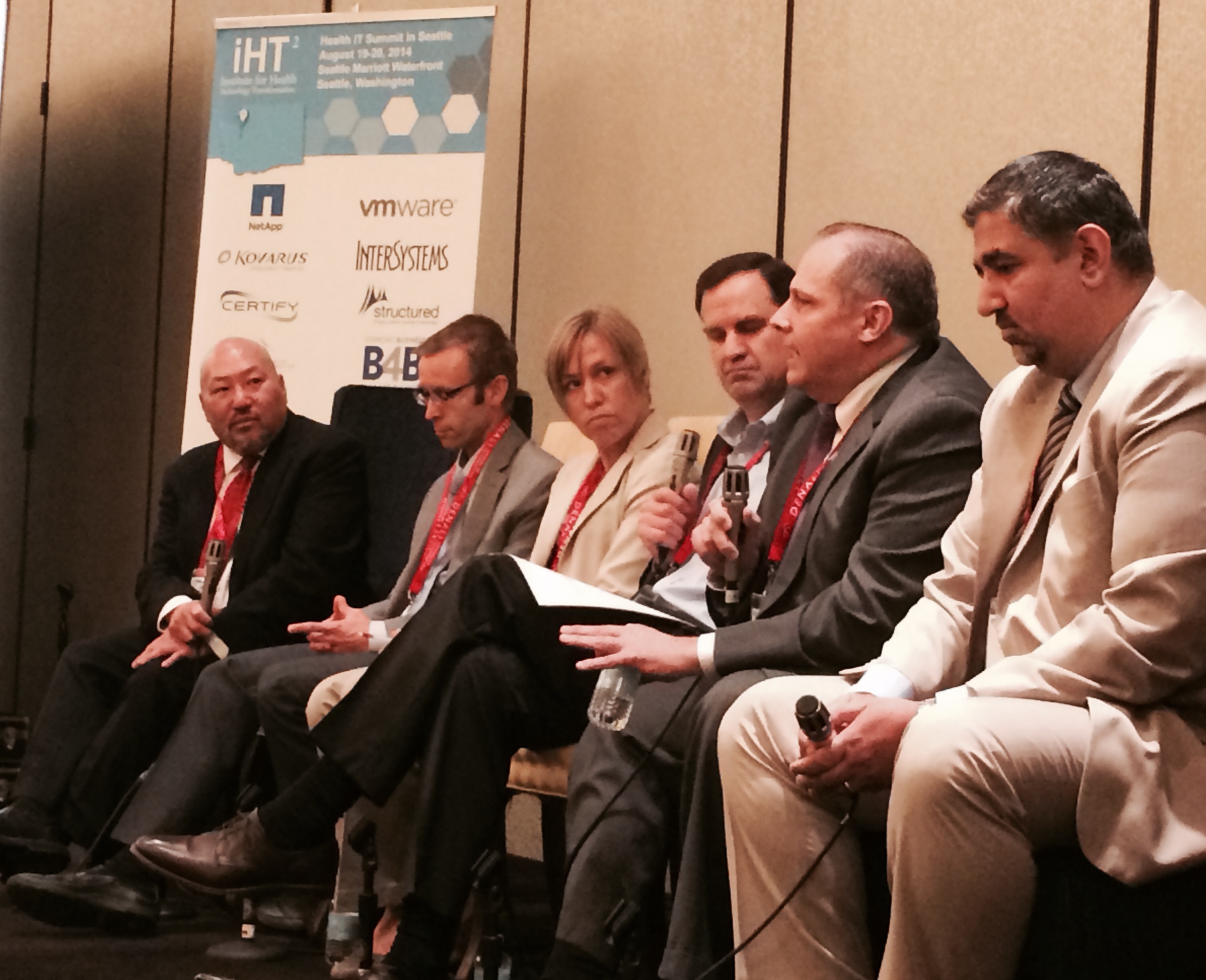
I had the pleasure of participating on a population health panel at an IHT2 conference held recently in Seattle.
As you’d expect, moderator Mark Hagland, Editor-in-Chief of Healthcare Informatics, drew on a variety of perspectives – primary care, public health, IT – from a variety of healthcare providers and vendors – to discuss what’s happening in population health management today and where we’re headed.
Some of the key Population Health points covered were:
- Moving from episodic, single-patient care to managing the health of populations represents a seismic shift that will require many years and tremendous patience to achieve, despite widespread industry commitment and focus. It’s going to take many years, for example, for physicians to change their way of thinking from operating as individual problem solvers to serving as members of a broader care team. They’ll need evidence that team-based care works.
- The ongoing debate about the pros and cons of electronic medical records underscores the need to significantly streamline clinician workflows and deliver IT solutions that work in a practical way. While a paper-based system might not measure up in terms of data quality, it’s a highly efficient way of capturing information. We need to find a way to maintain that level of efficiency with technology while improving data capture and quality.
- Success in population health requires looking holistically at the lives of patients and populations – factoring in their social, economic and physical environments, not just clinical data. Time spent between a patient and a doctor in a clinic or hospital is extremely limited. The vast majority of what impacts a patient’s health happens elsewhere. We need to put the patient at the center, engage the patient in his/her care through creative approaches and incentives like games or competitions, and establish a comprehensive community health record, not just a personal health record or EMR. We need to make that community health record easily accessible by the entire care team, including the pharmacist, the behavioral health specialist, the care manager, the primary care provider, and equally important, the patient.
- To make progress in population health management, healthcare organizations need to start small, focus on making an impact in a discrete area, and expand on that success. For example, a provider in Canada began their population health efforts by focusing on HIV-positive individuals. They set up one central resource to identify all treatment associated with HIV patients, connected databases, and proactively tracked when patients were diagnosed, how quickly they were linked to care, when they were put on Antiretroviral Drugs, etc., and helped them with housing needs. Their approach can serve as an effective blueprint for managing the health of other populations.
- Success in population health begins with collecting the right data and performing analytics to identify not just those patients that are costing your organization the most time and money today but those patients of highest risk of costing your organization the most next year. Once that risk has been identified, the extended care team can work together to address those patients’ needs proactively and keep them out of the high risk, high-cost category. Those analytics capabilities exist today.
- Last but not least, while we’re all concerned about identifying and addressing gaps in care to achieve the highest level of quality possible, we also need to focus on revenue. If an organization can identify revenue opportunities, it can invest more in care optimization going forward. “Without income there are no outcomes.”
Leave a reply